Company brain
What is a company brain?
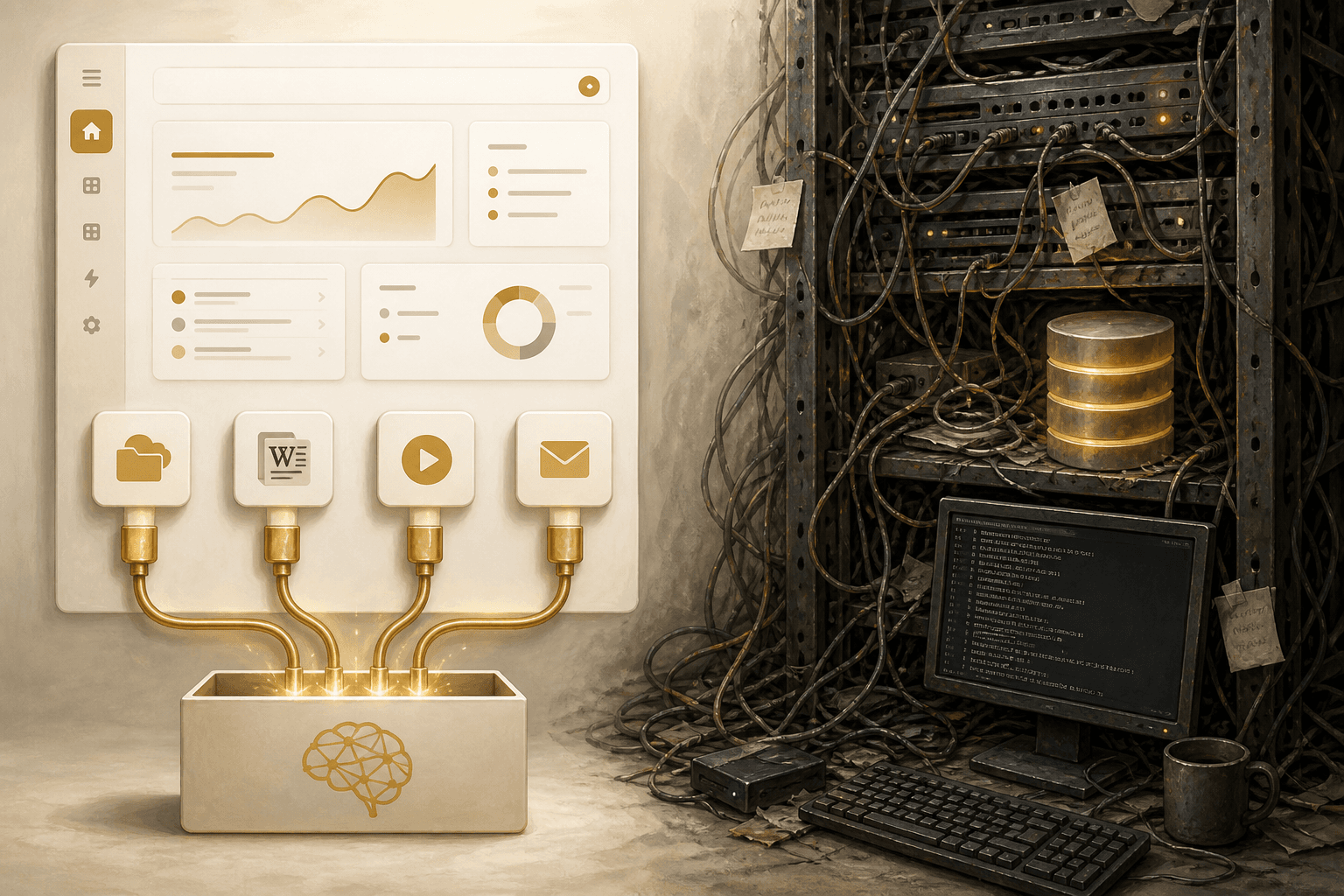
A memory store is an archive of facts. A company brain analyzes content, builds relationships, mines processes, uses memory, and answers on more than one surface, for a specific audience.
The job
A company brain is not just memory
A memory store is an archive of facts. You put knowledge in. You get the same facts back. That is useful storage. It is not a company brain.
A company brain analyzes what the company already produces, builds relationships, mines how work runs, uses memory in the answer, speaks in a personality you choose, and replies on more than one surface, for a specific audience.
- What it is: analysis, relationships, process, memory in use, personality, many surfaces, audience-specific answers
- What it is not: a pile of remembered facts waiting for a lookup
- Tricky Wombat is the product that does this job on hosted chat, Slack, widgets, and agents

Analyze
A company brain finds the concepts hidden in your knowledge
When you ask a question, a good company brain like Tricky Wombat does not just hand the model a stack of saved snippets and stop. It reads those passages for the ideas inside them. Two files often use different words for the same concept. One file often covers more than one idea.
A company brain groups like with like, then builds the answer from those distinct ideas. You get coverage of what the knowledge base is really talking about, not the same sentence repeated from the nearest matches.
- Find the concepts in the documents and materials you connected
- Group passages that mean the same thing, even when the wording differs
- Answer from those groups so each idea shows up once, in its own right
Relate
A company brain maps how people, topics, and documents connect
A smart company brain like Tricky Wombat writes a knowledge graph when your documents come in. People, topics, and documents become nodes with links between them. When you ask, the answer follows those links, not only the nearest saved passages.
Graph facts feed the reply. Citations still come from the source documents, so you see who said what and which file it came from.
- Write people, topics, and documents into a graph as you ingest
- Follow those relationships when someone asks
- Keep citations on the source files, not the graph alone


Mine
A company brain discovers how real work runs
A company brain needs to explore the knowledge you already have for process and workflow candidates. You see how work is described, where the steps sit, and which flows are worth a review.
You confirm or reject those candidates. A content-gap board shows what the brain still cannot answer after the first ingest.
- Mine process and workflow candidates from existing documents
- Confirm or reject the ones that match how you actually work
- Use a content-gap board to see what is still missing
Use
A company brain uses memory and speaks in a voice
A smart company brain like Tricky Wombat keeps user memory and a personality you pick. The next answer uses what it already knows about the asker, in the tone you set. Memory is an input to the turn.
Retrieval also follows who is allowed to know, including security from Google Drive, Confluence, Notion, SharePoint, Dropbox, and Box, and all the other locations where your knowledge lives.
- Store explicit user memory and use it on the next turn
- Pick a personality so the reply has a consistent voice
- Filter answers by who is allowed to know, including permissions from the original files

Is and is not
Company brain versus a memory store
A memory store archives facts. A company brain analyzes those facts, then answers as the company.
Comparison as of August 28, 2026
| Capability | Company brain | Memory store |
|---|---|---|
| Understand concepts: what the knowledge base is really talking about | Yes | - |
| Create relationships (people, topics, documents) | Yes | - |
| Mine processes and workflow candidates from documents | Yes | - |
| Use memory in the next answer (not only store it) | Yes | Partial1 |
| Personality you choose for the reply | Yes | - |
| Multiple access surfaces (chat, Slack, widget, WordPress, MCP) | Yes | Partial2 |
| Audience-specific answers (who is allowed to know) | Yes | Partial3 |
| Archive facts for later lookup | Yes | Yes |
- 1.A memory store keeps facts. Using those facts to change the next answer, with user memory, is the company-brain job.
- 2.A memory store often has one query path. Tricky Wombat answers in project chat, public or protected templates, widgets, WordPress, Slack at query time, and MCP for agents.
- 3.A memory store may have login. Audience-specific answers also filter retrieval by who you are, your role, and who can see each document, then shape the reply for that surface.
Legend: Yes = the company-brain job, as Tricky Wombat ships it · Partial = limited · - = archive behavior, not the brain. Memory store = an archive of facts. It is not a product column for a named vendor.
Company brain FAQ
What it is, and what it is not
A system that analyzes company content, builds relationships, mines processes, uses memory in the answer, speaks in a personality, and replies on more than one surface to a specific audience. Tricky Wombat is that product. Understanding concepts, mapping relationships, mining processes, using memory, and answering on widgets and chat are how the job is done, not extras on an archive.
A memory store. A memory store is an archive of facts. It saves what you put in and returns it later. It does not cluster meaning, map relationships, mine processes, use memory to change the next turn, or answer differently by audience and surface.
No. That is the memory-store job. Tricky Wombat still stores and retrieves. The company brain starts after that: reading what sources are about, mapping relationships, mining processes, personality, and access-controlled answers on chat, Slack, widgets, and agents.
Project chat, public or protected templates, embeddable widgets, WordPress, Slack with live search, and MCP for coding agents. A memory store usually offers one lookup. A company brain has many surfaces and still respects who is allowed to know.
Ask the company. Do not query an archive.
Connect a folder and Slack. See an answer that uses memory, not a dump of stored facts.
Schedule a callHow Tricky Wombat reads what sources are about · Process mining · Tricky Wombat vs GBrain