Tricky Wombat vs GBrain
GBrain is coding-agent memoryTricky Wombat is company intelligence
Garry Tan's GBrain is an open-source brain for Claude Code and OpenClaw. Creating, using, and maintaining it as institutional memory means git sources, Postgres, MCP, and a botmaster.
Tricky Wombat is the path for the entire company.
What GBrain is
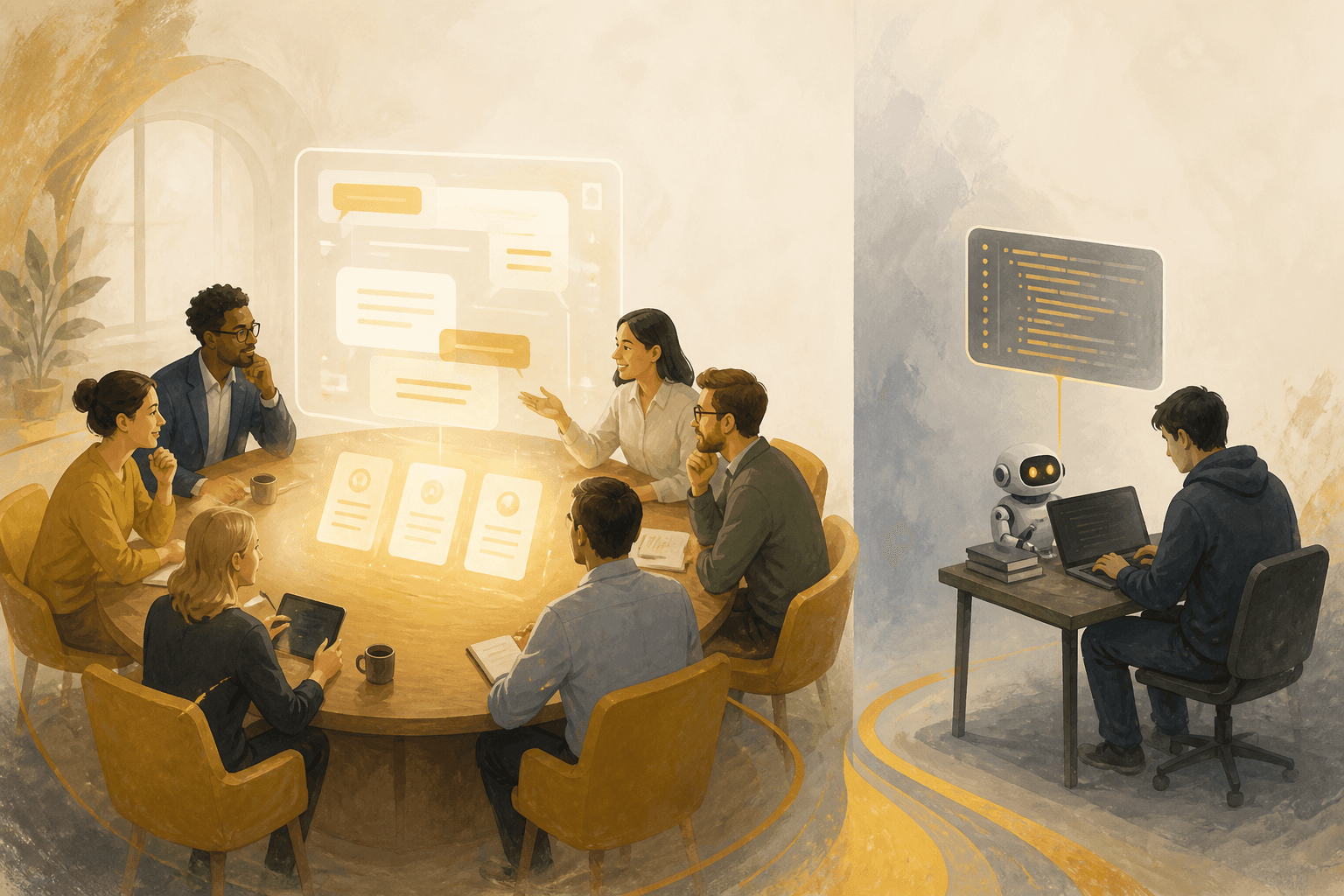
GBrain is shared memory for people and agents
Garry Tan is president of Y Combinator (2026). GBrain is the memory layer he built for his own agents: markdown pages in git, Postgres hybrid search, a self-wiring graph, and overnight jobs that enrich and consolidate. The GBrain tutorial is that personal install plus three additions: multiple sources in one brain, per-user OAuth so each person only sees allowed sources, and MCP so Claude Code, Codex, Cursor, or OpenClaw can query the same index. Tan wrote it for a 10 to 50 person company. YC listed company-brain as a Request for Startups shape (2026). Other YC companies in the category (2026) describe the same job: gather what the company already produces, keep it current, and serve permissioned context to humans and agents.
- GBrain: one owner, one git repo, one agent (often OpenClaw + Telegram)
- GBrain: several sources (shared, customers, internal), one OAuth client per person or agent
- GBrain: the ask surface is each teammate's coding agent, not a company AI discussion
- GBrain: what comes back is a cited answer, and a note on what the brain does not know


Create
Do you simply start a project? Or do you run your own server?
GBrain setup sits on a working personal agent. You move PGLite to Postgres, clone git repos onto a server, carve sources, bind MCP, put TLS in front, and mint client id/secret per person. Tan's recipe: about 90 minutes after the personal install, under $100/month in model cost for 25 people, plus hosting. Onboarding is the botmaster pattern: seed each hire's slice, walk two or three flows, then hand credentials. About 45 minutes each.
On Tricky Wombat, you create a project. You add people, assign roles, and connect sources. Knowledge arrives from the cloud, wikis, meetings, video, email, blogs, Substack, and URLs. Tricky Wombat can then watch those sources for updates. You do not provision Postgres or an MCP daemon to get the first cited answer.
- Tricky Wombat: Cloud StorageGoogle Drive, Dropbox, Box, S3, WikisNotion, Confluence, SharePoint, Learning SystemsKajabi, Circle, Meeting NotesFathom, Granola, Fireflies, Pocket, Video, Newsletters, Email and Webblogs, URLs, then watched for updates
- Tricky Wombat: Chat, CRMHubSpot, Salesforce and Work trackingJira, Monday.com, ClickUp stay live at query time (Real Time Search). They are not copied into a markdown source.
- GBrain: git checkouts on disk, then `gbrain sync --all`. Cold-start and ingest skills exist when you wire them.
- GBrain: you are the installer.Tricky Wombat: as simple as connecting sources.
Use
Can anyone on the team ask a question in chat? Or is access primarily from a coding tool?
GBrain is used from each teammate's AI client pointed at your MCP. Thin CLI on the laptop. That's the product.
Tricky Wombat answers in chat, public or protected templates, embeddable widgets, and WordPress. One turn can search the index, hit live Slack, HubSpot, or Salesforce with user credentials, cite timestamps, offer an assessment, or take an action such as scheduling a meeting. Retrieval is access controlled. Curated answers can sit in front of retrieval after review.
GBrain MCP into Claude Code is a real strength.
- Tricky Wombat: ask in chat, on a site widget, in WordPress, or behind an access code
- Tricky Wombat: live answers from Slack, HubSpot, Jira, Salesforce, Monday.com, and ClickUp, using each person's own access
- Tricky Wombat: human-reviewed Q&A first, then search across documents and how they connect
- GBrain: a cited answer inside the coding agent, plus a note on what is missing

Maintain
Does the product watch sources and review answers? Or do you write your own scheduled jobs?
GBrain maintenance is operator work: `gbrain sync --all`, `gbrain autopilot`, `gbrain doctor --remediate`, per-person cron markdown, 30-day harness token reissue, OAuth rescope when you add a source, Postgres connection limits under parallel sync, and a Docker-network warning (a container that can reach Postgres skips OAuth). Skill routing is a harness convention, not a GBrain hard gate.
Tricky Wombat maintenance is built into the product: Document watch with deduplication, playlist sweeps, approved response review, content-gap dashboard, access controls, 2FA, Zero Data Retention.
GBrain isolation is source-granular: everyone who can read `customers` can read every folder in `customers`.
- Tricky Wombat freshness: per-URL Watch, provider folder/space watches, playlist and publication sweeps
- Tricky Wombat quality: accept, edit, or decline suggested answers, mark what is missing, and open the cited sources
- GBrain freshness: git sync plus skills you scaffold (Slack scan vs archive, Granola, Linear)
- GBrain: dream cycle compounds pages overnight on the host. Tricky Wombat does not ship that loop.
What GBrain is better at
Keep GBrain if the brain belongs to coding agents you operate
GBrain is a great memory layer for a technical operator who already lives in Claude Code or OpenClaw. Markdown you can git diff after the overnight jobs. MCP into the harness you already pay for. Cheap at 25 people if you will staff a botmaster.
Tricky Wombat is not a local markdown editor and not a Claude Code plugin.
If the only people who need answers already use a coding tool, and you onboard them yourself, GBrain is an appropriate solution.
Once employees, customers, widgets, access controls, or live CRM enter the picture, self-hosting GBrain is a complicated challenge.
- GBrain: files in git you can grep, PR, and rebuild the index from
- GBrain: first-class MCP for Claude Code, Codex, Cursor, Claude Desktop, ChatGPT
- GBrain: overnight enrichment, citation fixer, and `gbrain think` gap notes
- GBrain: MIT license, your hardware, your keys

Create
How you set it up and add your knowledge
With GBrain, you install the software and add markdown files. With Tricky Wombat, you connect the systems that already hold the work.
Comparison as of August 22, 2026
| Capability | Tricky Wombat | GBrain |
|---|---|---|
| Hosted project: users, roles, vault, no server | Yes | - |
| Add a non-technical teammate from admin UI | Yes | - |
| Cloud folder import and watch (Drive / Dropbox / Box / OneDrive) | Yes | - |
| Wiki / LMS space sync (Notion, Confluence, SharePoint, courses) | Yes | - |
| Meeting-notes connectors (Fathom, Granola, Fireflies, Pocket) | Yes | Partial1 |
| Web ingest, JavaScript render, per-URL Watch | Yes | - |
| YouTube transcripts and playlist watch | Yes | - |
| Inbound email → document | Yes | Partial2 |
| Query-time live Slack / CRM (not a copied archive) | Yes | Partial3 |
| Markdown in git as the operator-owned system of record | - | Yes |
| Self-host Postgres + TLS MCP (no vendor login) | - | Yes |
| Botmaster seeds each hire's slice before first query | - | Yes4 |
- 1.GBrain meeting-notes connectors are Partial: extra setup on top of git files, not a built-in connector.
- 2.GBrain inbound email is Partial: mail can become files with extra setup, not a built-in inbox.
- 3.GBrain live Slack and CRM is Partial: it copies Slack into files, while Tricky Wombat searches Slack when you ask.
- 4.GBrain needs someone to set up each teammate by hand (about 45 minutes); Tricky Wombat just adds them to the project.
Legend: Yes = productized support · Partial = limited, DIY, skill/cron, or incomplete · - = not a documented product feature. GBrain column = official GBrain path (multi-user Postgres, sources, MCP, per-teammate OAuth).
Use
How people and agents get an answer
GBrain use is MCP into a coding agent. Tricky Wombat use is permissioned chat for the rest of the company, plus live systems in the same turn.
Comparison as of August 22, 2026
| Capability | Tricky Wombat | GBrain |
|---|---|---|
| Browser chat, widget, or WordPress embed | Yes | - |
| Answers that cite the source and when it was said | Yes | Partial2 |
| Live + indexed retrieval in one answer | Yes | Partial3 |
| Each person connects their own Slack, CRM, and work tools | Yes | - |
| Each person only sees sources they are already allowed to see | Yes | Partial4 |
| Human-reviewed answers, approved before they go live | Yes | - |
| Answers that follow how people, topics, and documents connect | Yes6 | Yes6 |
| Agentic write-back from the same chat turn | Yes | Partial5 |
| Assessments offered from chat or widget | Yes | - |
| Process mining / workflow candidates from documents | Yes | - |
| Cited synthesized answer plus "what we do not know yet" | Partial1 | Yes |
| Claude Code / Codex / Cursor via MCP as the client | - | Yes |
- 1.Tricky Wombat is Partial on saying what is still unknown in the answer; it tracks gaps in a dashboard, while GBrain can say it in the answer.
- 2.GBrain is Partial on citing the source and when it was said: it cites saved files, not company chat, widgets, or WordPress.
- 3.GBrain is Partial on live and saved knowledge in one answer because Slack is copied into files first.
- 4.GBrain is Partial on access: anyone who can read a source can read every folder in it.
- 5.GBrain is Partial on taking action from the same conversation: that happens in the coding tool, not company chat.
- 6.Both record how people, topics, and documents connect, but they build those links in different ways.
Legend: Yes = productized support · Partial = limited, DIY, skill/cron, or incomplete · - = not a documented product feature. GBrain column = official GBrain path (multi-user Postgres, sources, MCP, per-teammate OAuth).
Maintain
How you keep knowledge current and reviewed
With GBrain, keeping knowledge current is work you run. With Tricky Wombat, watching sources, reviewing answers, and managing access are part of the product.
Comparison as of August 22, 2026
| Capability | Tricky Wombat | GBrain |
|---|---|---|
| Skip refresh when a source has not changed | Yes | Partial1 |
| Scheduled watches (web, playlists, publications) without writing crons | Yes | Partial2 |
| Content-gap analytics (repeat questions with no good answer) | Yes | Partial3 |
| Human review queue for auto-captured answers | Yes | - |
| Fine-grained roles on knowledge (not only source OAuth) | Yes | Partial4 |
| MFA and contractual zero data retention on the knowledge product | Yes | -5 |
| SSO / SCIM org provisioning | Yes | - |
| Cross-source contradiction detection | Partial6 | Partial6 |
| Git history / PR review as the change log | - | Yes |
| Overnight dream cycle / citation fixer on a host you run | - | Yes |
| Per-document last-verified / fact check queue | - | - |
- 1.GBrain is Partial on skipping unchanged sources: git updates can skip work, but skipping unchanged web pages is Tricky Wombat.
- 2.GBrain is Partial on scheduled watches: Tricky Wombat watches in the product, GBrain needs jobs you write.
- 3.GBrain is Partial on repeat failed questions: it can note a gap in an answer, not a company list of them.
- 4.GBrain is Partial on roles: you can limit a person to a source, not to folders inside it.
- 5.GBrain does not include two-factor sign-in or a no-training-data contract; Tricky Wombat does.
- 6.Both are Partial on contradictions: GBrain describes a process, Tricky Wombat does not yet use conflicts in the answer.
Legend: Yes = productized support · Partial = limited, DIY, skill/cron, or incomplete · - = not a documented product feature. GBrain column = official GBrain path (multi-user Postgres, sources, MCP, per-teammate OAuth).
Company Brain FAQ
GBrain as DIY, Tricky Wombat as product
Shared institutional memory on top of a personal GBrain: several markdown sources, one OAuth client per person or agent, and MCP so each teammate's coding agent queries the same index with source-scoped reads. Tan wrote the tutorial for 10 to 50 people. It is not a thin web app.
You do. Sync git sources, keep Postgres healthy, rotate 30-day harness tokens, rescope clients when sources change, write crons and skills, and onboard each hire so their slice is not empty. Tan calls that the botmaster pattern. Tricky Wombat operators connect sources, set roles, review suggested answers, and watch URLs. They do not self-host Postgres or an MCP daemon.
GBrain isolation is at the source, plus optional write prefixes. Everyone who can read `customers` can read every folder in `customers`. Tricky Wombat retrieval filters by principal, role, and document ACL, including grants mirrored from Drive, OneDrive, Confluence, Notion, SharePoint, Dropbox, and Box where those providers expose them.
Yes. Tricky Wombat ships an MCP server and API access, so Claude Code, Cursor, and other agents can query the company index. That path is not a row in the comparison tables on this page, which stay scoped to create, use, and maintain as a product. GBrain still makes MCP-into-the-harness the primary surface. Tricky Wombat still leads with hosted chat, widgets, live Real Time Search, and governed RAG for people who will not install a harness.
Ask the company, not only the repo.
Connect a folder and Slack. See who can ask without installing a harness.
Schedule a call