Cognitive Resonance
Two people describing the same concept use the same keyword less than 20% of the time. That finding, from a 1987 Bell Communications study, is one of the most cited in information retrieval history. It means keyword search fails not because of bad implementation but because of how language works. Cognitive resonance is the retrieval of information based on meaning similarity rather than language overlap. Instead of matching the exact words in a query against the exact words in a document, the system encodes both as vector representations in a space where conceptually related items sit near each other. A search for "customer churn" finds the document titled "retention rate modeling" because the concepts are adjacent, even though the words are not. When the same question is asked twice in different words, cognitive resonance recognizes the semantic overlap and serves the validated answer, reducing latency by 3-4x and eliminating redundant computation across roughly 31% of enterprise queries. The vocabulary problem does not disappear with a better model. It disappears with a system that matches meaning instead of strings.
Additional documents available for download
 Explainer Infographic
 Explainer slide deck
Why matching words was never the same as matching meaning
In 1987, four researchers at Bell Communications tested something that most software teams still take for granted: whether two people would use the same word to describe the same thing. The answer was no. Across five domains, the probability of two users choosing the same keyword for the same concept fell below 0.20.[1] Systems built on a single designer-chosen keyword faced 80 to 90 percent failure rates in common retrieval scenarios. That paper is one of the most cited in information retrieval history. Thirty-eight years later, most enterprise search still runs on the same keyword-matching logic those researchers proved was broken.
Why does keyword search keep failing?
This vocabulary problem is not a design flaw that better UIs can fix. It is a property of natural language itself. People think in concepts, while search boxes expect strings. The gap between those two things creates failures that compound across every team, project, and knowledge base in an organization.
The numbers have gotten worse as organizations have grown more complex.[3] That time is not just lost to inefficiency. It distorts decisions. A Gartner survey found that 44% of users reported making incorrect decisions because relevant data existed within their organization but was never surfaced by existing search systems.[2]
IDC put a dollar figure on the problem: an enterprise with 1,000 knowledge workers wastes an average of $5.7 million annually due to failed search, with workers successfully finding what they need only 56% of the time.[4] And 61% of those workers reported needing to access four or more systems to find what they need.

Credit: Tricky Wombat made with Google Gemini 3.1 Flash Image, Mar 2026
The underlying issue is architectural. Keyword search treats documents as bags of tokens and queries as exact-match lookups against those tokens. A team member searching for "customer churn analysis" will not find the document titled "retention rate modeling" unless both terms happen to appear in the same file. The system has no representation of what either phrase means.
What changes when search matches concepts instead of keywords?
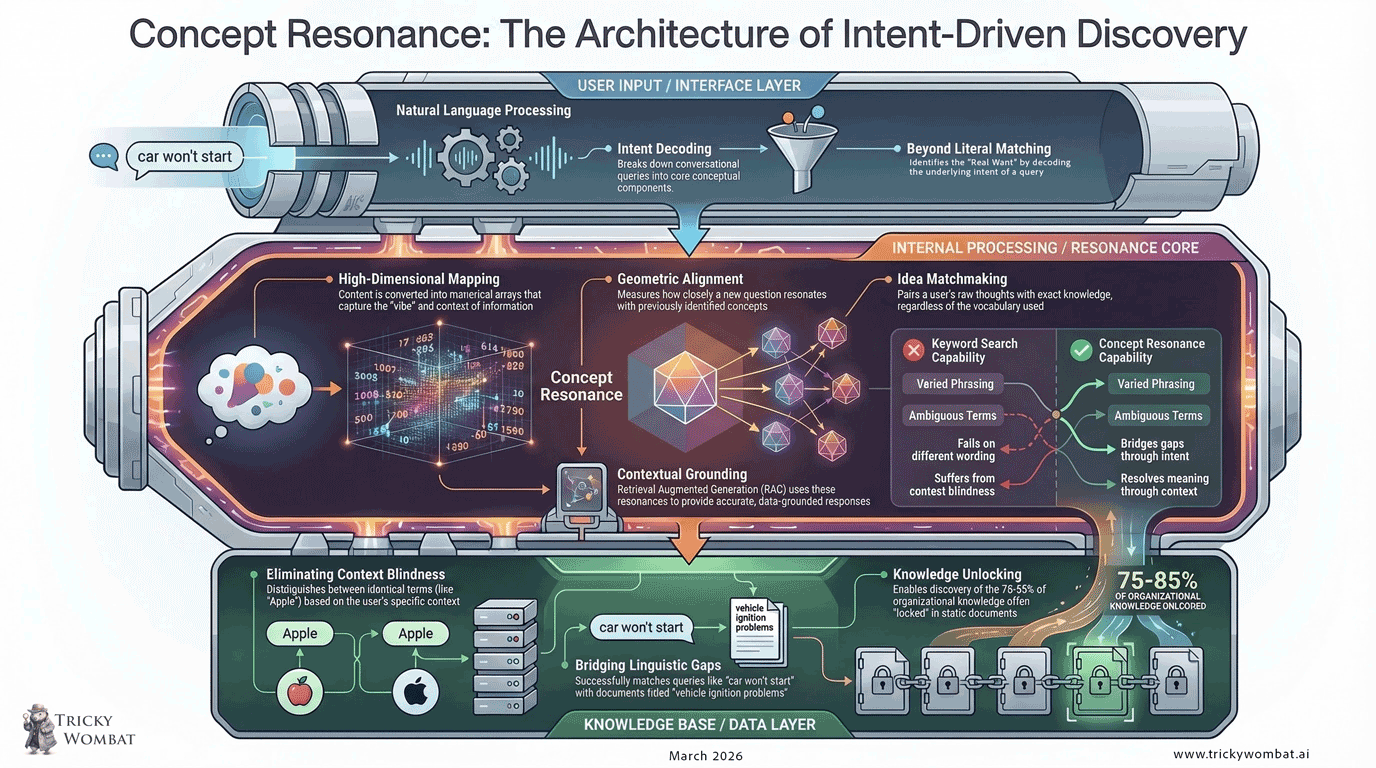
Cognitive Resonance (also called semantic search) is the retrieval of documents based on meaning similarity rather than language overlap. The idea behind cognitive resonance is that certain ideas have a similarity: a resonance. Ideas and concepts can be closely linked even through they use completely different wording.
Instead of matching strings, the system encodes both queries and documents as dense vector representations (embeddings) in a high-dimensional space where conceptually related items cluster together. A query about "customer churn" and a document about "retention modeling" end up near each other in vector space even though they share no keywords.
The academic evidence for this shift is strong and specific.

Credit: Tricky Wombat made with Google Gemini 3.1 Flash Image, Mar 2026
Those numbers deserve an honest caveat. You can’t just semantically search where there are times that exact lexical and language identification work best. For example, searching "ERR-4502" through vector search returns results about errors in general rather than the specific code. Product numbers, legal citations, API function names, and error codes all live in a space where exact match still beats meaning match.[5]
This is the gap that pure semantic search alone cannot close. Matching concepts is necessary. It is not sufficient.
The best results come from reasoning layers
Cognitive search is the term Forrester and Gartner use for what happens when you add intent understanding, contextual reasoning, and adaptive learning on top of embedding-based retrieval. Forrester defines it as "a new generation of enterprise search employing AI technologies such as NLP and ML to ingest, understand, organize, and query digital content from multiple data sources."[6] Gartner's equivalent term, insight engines, describes systems that "apply relevancy methods to describe, discover, organize, and analyze data" with richer indexes, more complex queries, and multiple touchpoints.[7]
Cognitive resonance is at the intersection of both terms.
Stacking layers on the search process (exact-match, then concept similarity, then cross-encoder reranking) puts together a system where performance difference is measurable.

Credit: Tricky Wombat made with Google Gemini 3.1 Flash Image, Mar 2026
Retrieval precision also matters more than retrieval volume. Stanford researchers showed that language model accuracy follows a U-shaped curve when processing retrieved context: performance is highest when relevant information sits at the beginning or end of the input, dropping to roughly 25% accuracy when relevant content falls in the middle. Adding more documents provides almost no benefit.
The filtering approach, which uses semantic metrics to remove low-relevance passages before they reach the language model, reduces hallucinations by up to 64%.
What happens when semantically identical queries repeat?
There is a parallel infrastructure problem hiding inside every AI-powered search deployment: query redundancy. An analysis of real-world ChatGPT conversation data found that approximately 31% of all queries are semantically similar to previously submitted queries.[8] That represents massive redundancy in any deployment that processes each query from scratch.
Cognitive Resonance addresses this by matching incoming queries against previously processed queries based on meaning rather than exact string match. If someone asked "What is our return policy for damaged items?" yesterday and someone asks "How do we handle returns on defective products?" today, cognitive resonance recognizes those as functionally equivalent and serves the cached response.

Credit: Tricky Wombat made with Google Gemini 3.1 Flash Image, Mar 2026
Speed matters for user experience. A Google Cloud implementation measured the latency impact directly[9]: a document Q&A pipeline with semantic caching reduced retrieval time from roughly 6,504ms to 1,919ms, a 3.4x improvement.
Cognitive resonance is the protective layer that avoids semantic redundancy. Speed and latency is not the only benefit to cognitive resonance.
Accuracy and relevancy are the primary benefits to cognitive resonance. When two queries that essentially ask the same question, the correct answer is always surfaced from the semantic cache.
In the example above, the two queries:
- "What is our return policy for damaged items?"
- "How do we handle returns on defective products?"
Should return the approved answer for damaged/defective returns. Knowing that the approved response will be returned increases query response confidence.
Is a smart context-aware pipeline being implemented?
RAG adoption among enterprise AI implementations surged from 31% to 51% between 2023 and 2024, with enterprise search capturing 28% of all GenAI use cases.[10]
Although 78% of organizations report using AI in at least one business function over 80% say they are not yet seeing tangible enterprise-level impact.[11]
Spending is accelerating. Adoption is accelerating. Results are lagging.

Credit: Tricky Wombat made with Google Gemini 3.1 Flash Image, Mar 2026
One explanation is retrieval quality. Organizations are deploying AI on top of their existing knowledge bases, but the search and retrieval layer between the AI model and the organizational data remains primitive. The model is only as good as the context it receives. When retrieval sends irrelevant or poorly ranked documents to the language model, the output degrades regardless of how capable the model is.
Forrester case studies support this interpretation. Siemens saved $1.9 million in headcount costs from a cognitive search implementation. Cisco support engineers save 5,000 hours per month.[12] The organizations seeing returns are the ones investing in the retrieval layer, not the generation layer.
What should you evaluate in a concept-level retrieval system?
If you are evaluating search or retrieval systems for an AI-powered knowledge deployment, five questions will separate the systems that work from the ones that produce impressive demos and disappointing production results.
- Does the system combine keyword and semantic retrieval? Any system relying on keyword search only will miss the 80% of queries are different than document language.
- Does the system include a reasoning or reranking layer? Cross-encoder reranking can outperform bi-encoders.
- How does the system handle domain-specific content? General-purpose embedding models fail on domain terminology.
- Does the system implement semantic caching? With 31% of queries being semantic near-duplicates, cognitive resonance provide near zero latency with increase accuracy.
- How does the system handle retrieval precision versus recall? The "Lost in the Middle" finding is a practical constraint.More retrieved documents is not better. Better-ranked fewer documents is better.
The retrieval layer is the bottleneck
The most consequential technical decision in an AI-powered knowledge system is not which language model to use. It is how the system finds and ranks the context that the model reads before generating a response. The vocabulary problem has not gone away. It has been amplified by the volume and fragmentation of modern organizational knowledge.
The systems that close this gap combine semantic matching with keyword precision, add reasoning layers that judge relevance rather than measuring distance, and use semantic caching increase accuracy at scale.
This layered approach to concept-level retrieval, what we use at Tricky Wombat, is the infrastructure that determines whether an organization's AI deployment produces reliable answers or plausible-sounding hallucinations.
The 80% vocabulary mismatch is not a problem that disappears with a better model. It disappears with a better question of what "matching" means.
Enterprise search fails on the first attempt about 90% of the time. The gap is not the model. It is the retrieval layer between the model and your data, the step where a user's question has to find the right document despite different vocabulary, scattered sources, and no shared terminology. Tricky Wombat's cognitive resonance pipeline combines semantic matching, keyword precision, cross-encoder reranking, and semantic caching into the retrieval infrastructure that determines whether your AI deployment produces reliable answers or plausible-sounding ones. A 30-minute call will map your current retrieval architecture and identify where meaning-based matching would change result quality. Schedule a call.
▶References (12)
- ↩Furnas, G.W., Landauer, T.K., Gomez, L.M., and Dumais, S.T. "The Vocabulary Problem in Human-System Communication." *Communications of the ACM*, Vol. 30, No. 11, pp. 964-971, November 1987. https://dl.acm.org/doi/10.1145/32206.32212
- ↩Gartner survey, referenced via Gartner Insight Engines market analysis. https://aiimi.com/insights/insight-engines-search-scale-insight-secure
- ↩McKinsey Global Institute. *The Social Economy: Unlocking Value and Productivity Through Social Technologies.* July 2012. https://www.mckinsey.com/industries/technology-media-and-telecommunications/our-insights/the-social-economy
- ↩IDC. *The Knowledge Quotient: Unlocking the Hidden Value of Information Using Search & Content Analytics.* June 2014. (Note: multiclient study sponsored by Coveo, Lexalytics, and other search vendors.) https://www.businesswire.com/news/home/20140715005986/en/New-IDC-Study-Uncovers-Best-Practices-in-Unlocking-the-Hidden-Value-of-Information
- ↩Redis. "Semantic Search vs. Keyword Search." https://redis.io/blog/semantic-search-vs-keyword-search/
- ↩Forrester. "Cognitive Search Is the AI Version of Enterprise Search." Blog by Mike Gualtieri, June 2017. https://www.forrester.com/blogs/17-06-12-cognitive_search_is_the_ai_version_of_enterprise_search/
- ↩Gartner IT Glossary & *Magic Quadrant for Insight Engines*, December 2022. https://www.gartner.com/en/information-technology/glossary/insight-engines
- ↩Gill et al. "MeanCache: User-Centric Semantic Cache for LLM Web Services." arXiv:2403.02694, March 2024. Accepted at IEEE IPDPS 2025. https://arxiv.org/abs/2403.02694
- ↩Arun Shankar. "Implementing Semantic Caching: A Step-by-Step Guide." Google Cloud Community blog, 2024. https://medium.com/google-cloud/implementing-semantic-caching-a-step-by-step-guide-to-faster-cost-effective-genai-workflows-ef85d8e72883
- ↩Menlo Ventures. "2024: The State of Generative AI in the Enterprise." November 2024. (Note: Menlo Ventures has investments in Anthropic and Pinecone.) https://menlovc.com/2024-the-state-of-generative-ai-in-the-enterprise/
- ↩McKinsey & Company. "The State of AI: How Organizations Are Rewiring to Capture Value." March 2025. https://www.mckinsey.com/capabilities/quantumblack/our-insights/the-state-of-ai
- ↩Forrester Wave: Cognitive Search Platforms, Q2 2025. https://www.forrester.com/report/the-cognitive-search-platforms-landscape-q2-2025/RES184016