User Memory
Every major AI platform now stores facts between sessions. ChatGPT, Claude, Gemini, and Copilot all remember your name, your job title, your language preferences. The blank context window is gone. What replaced it is a subtler problem: these systems remember what you told them, not what that information means in context. They store that you are a platform engineer but not that your last three infrastructure proposals were rejected for missing cost-per-query projections. That gap between fact storage and contextual adaptation is user memory, the persistent infrastructure layer that retains decision history, project constraints, communication patterns, and evolving priorities across conversations. BCG estimates $2 trillion in revenue will shift over the next five years to companies that close it.
Additional documents available for download
 Explainer slide deck
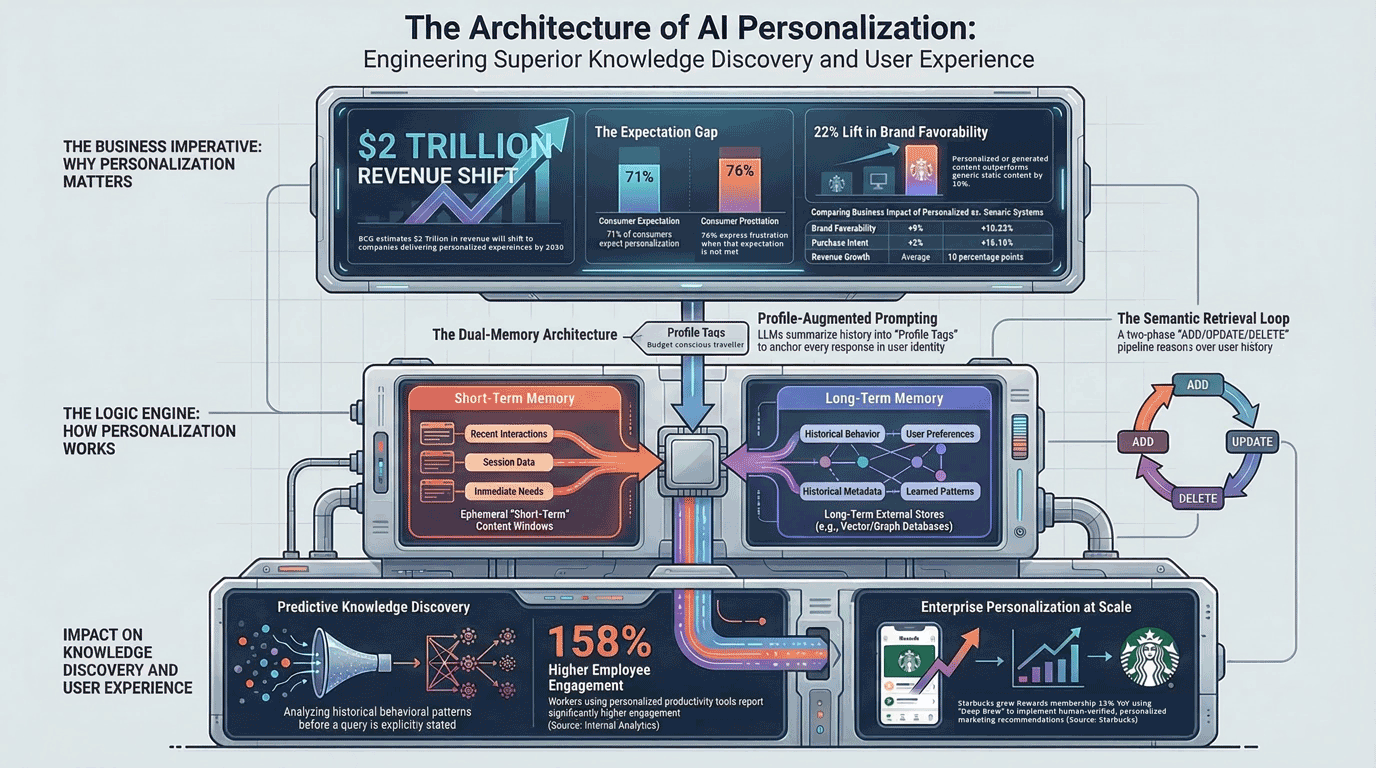 Explainer infographic
Why Do Most AI Responses Feel Robotic?
It is not just data quality or infrastructure. It’s the personalized touch, the answer that seemingly was written just for you, that gives users the sense that AI is speaking directly to them. And that matters.
BCG estimates $2 trillion in revenue will shift over the next five years to companies that deliver personalized experiences, with leaders in personalization growing revenue 10 percentage points faster annually. [1]
The gap between those numbers tells a specific story: AI systems are getting smarter, but they forget everything between conversations. The problem is not intelligence. It is memory.
Why does your AI remember your name but not what matters?
The Groundhog Day problem has a new shape. A year ago, every conversation with an LLM started from zero. Users re-explained their role, their preferences, their constraints, their project context. Bill Murray woke up to Sonny and Cher every morning. Your AI assistant woke up to a blank context window every session.
That version of the problem is mostly solved. By mid-2025, every major AI vendor had shipped persistent memory. ChatGPT, Claude, Gemini, Copilot, and Perplexity all store facts across sessions.[2]
You can ask ChatGPT "What do you remember about me?" and get an answer back. The blank context window is gone.
What replaced it is more subtle and, for enterprise use, more damaging. These memory systems capture surface-level facts: your name, your job title, that you prefer Python over JavaScript.
They do not capture the contextual depth that makes interactions useful: your team's terminology, your project constraints, your communication patterns across different stakeholders, the decision history behind your current architecture choices.
The AI remembers that you're a platform engineer. It does not remember that your last three infrastructure proposals were rejected because they lacked cost-per-query projections.

Credit: Tricky Wombat made with Google Gemini 3.1 Flash Image, Mar 2026
The gap is measurable. On LongMemEval, a benchmark testing five memory abilities across 500 questions, commercial systems including GPT-4o achieved only 30 to 70% accuracy on recall tasks that go beyond simple fact retrieval, like synthesizing information across sessions or tracking how user preferences change over time.[3]
These are exactly the tasks that separate "memory" from "personalization." Remembering a stated preference is easy. Noticing that a user's priorities shifted based on a conversation two weeks ago is hard. The best purpose-built memory systems have only recently crossed 90% on LongMemEval, and they require dedicated infrastructure layers that no consumer AI product provides out of the box.[4]
The MIT NANDA report on enterprise AI usage captured the consequence: employees use AI tools for brainstorming and low-stakes tasks but abandon them for mission-critical work because the tools cannot retain meaningful context.[5]
The 90% of employees using consumer AI tools at work are, in effect, manually re-engineering personalization every session. They paste context. They re-explain constraints. They rebuild the working relationship from scratch, not because the model forgot everything, but because it forgot everything that mattered.
The consumer data tells the same story from the demand side. McKinsey found that 71% of consumers expect personalized interactions, and 76% express frustration when that expectation goes unmet.[6]
Those numbers describe a world where "personalization" means the system adapts to you, not one where you adapt to the system by feeding it your context on every interaction. A peer-reviewed study of a chatbot reinforced the pattern, finding that repetitiveness and lack of context-awareness were primary drivers of user dissatisfaction, and that genuine personalization could meaningfully improve engagement.
Gartner projected that at least 30% of generative AI projects would be abandoned after proof of concept by the end of 2025, citing poor data quality, unclear business value, and escalating costs.
What does memory architecture look like inside an LLM system?
Understanding the engineering requires separating two things that sound similar but work differently: short-term memory and long-term memory.
Short-term memory is the context window itself. It is the rolling buffer of recent conversation turns, system prompts, and any retrieved context the system injects before each inference call. It is fast and immediate, but finite (4K to 200K tokens depending on the model, and now up to 1 million+ tokens with Google’s new Gemini Pro 1.5) and ephemeral. When the conversation ends, so does the context window.
Long-term memory lives in external persistent stores: vector databases, graph databases, or key-value stores. Information is extracted during or after conversations, then selectively retrieved and injected into the context window when a future session begins. The two systems interact through a retrieval loop. On each new query, the system searches long-term memory for relevant context, then appends results alongside recent messages before the model processes anything.

Credit: Tricky Wombat made with Google Gemini 3.1 Flash Image, Mar 2026
How do memory systems decide what to remember?
The mechanics of memory go beyond storage and retrieval. Modern systems do not just append new facts. They consolidate.
An LLM extracts candidate facts from the conversation. A user says "I just moved to Portland and started a new role as a data engineer." The extraction step distills this into discrete atomic facts: "User lives in Portland" and "User's role is data engineer."

Credit: Tricky Wombat made with Google Gemini 3.1 Flash Image, Mar 2026
This LLM-as-classifier approach replaced brittle rule-based logic with semantic reasoning. If a user previously said "I work at Acme" and later says "I just joined Beta Corp," the classifier recognizes the contradiction and makes corrections.
By mid-2025, every major AI vendor confirmed the architectural direction. OpenAI, Anthropic, and Google all shipped persistent memory features for their consumer products, converging on the same conclusion from different starting points: memory is infrastructure, not a model-level feature.
What is the business case for memory infrastructure?
The revenue argument is straightforward. McKinsey found that companies leading in personalization generate 40% more revenue[6] from those activities than average performers. BCG quantified the total opportunity at $2 trillion shifting to companies that deliver personalized experiences over the next five years. These numbers describe the ceiling. The floor is defined by what happens without memory infrastructure.
The failure pattern is specific. Gartner's projection that 30% of generative AI projects would be abandoned after proof of concept maps directly to the infrastructure gap.
Trust compounds the challenge. Salesforce Research found that 72% of consumers trust companies less than a year ago, and 60% say AI makes trust more important than before.[7] But the same survey found that over a third of consumers would willingly work with an AI agent specifically to avoid repeating themselves. Users want memory. They also distrust the systems that provide it.
This tension is quantified on both sides. Pew Research found that 81% of consumers believe AI-collected information will be used in ways they find uncomfortable. [8]
The business implication is that memory infrastructure is not optional for AI products that interact with the same users repeatedly. Without it, every session is a cold start, personalization is impossible, and the system trains users to expect less from it over time.
What should you evaluate for memory infrastructure?
Three questions matter more than feature comparisons.
- Understand your retrieval pattern. If your users build ongoing context across sessions, tracking projects, evolving preferences, and relational information ("who owns this deliverable"), you need graph capabilities or a hybrid architecture.
- Define your privacy posture up front. Memory creates a data governance surface that did not exist before. You need answers to: who can view stored memories, how long they persist, whether users can edit or delete them, and how your system handles the right to be forgotten.
- Plan for memory errors and staleness from day one. Extraction pipelines will misclassify facts. Memories will go stale as user circumstances change. The question is not whether these failures happen but how your system detects and recovers from them.
If you are building in-house, budget for the extraction pipeline as a first-class system, not an afterthought. It is the single most impactful component in the entire memory stack.
The infrastructure layer that was always missing
Twenty years ago, web applications stored session state in cookies and hoped for the best. Then session stores, caching layers, and CDNs became standard infrastructure. Nobody argued that Apache needed to be a smarter web server. The answer was better infrastructure around it.
AI systems are at the same inflection point. The models are capable. The persistence layer between conversations is what does not exist yet in most deployments. RAND's 80% failure rate, Gartner's 30% abandonment rate, McKinsey's frustrated 76%, all trace back to the same missing layer.
Memory is the next infrastructure primitive in the AI stack. The teams that treat it as such, building extraction pipelines, retrieval systems, and governance frameworks alongside their models, will build products that get better with every conversation. The ones waiting for a smarter model to solve the problem will keep waking up to Sonny and Cher.
Your model is not the bottleneck. The persistence layer between conversations is. Most teams discover this after proof of concept, when the system that performed well in demos starts every real user interaction from zero. A 30-minute architecture review with Tricky Wombat's team will map where your pipeline loses context, what a memory layer needs to retain for your specific use case, and what it takes to build one. Schedule a call.
▶References (8)
- ↩BCG. "Personalized: Customer Strategy in the Age of AI." October 2024. https://www.bcg.com/press/15october2024-capturing-the-2-trillion-personalization-opportunity-with-ai
- ↩What We Risk When AI Systems Remember https://www.techpolicy.press/what-we-risk-when-ai-systems-remember/
- ↩Wu, D. et al. "LongMemEval: Benchmarking Chat Assistants on Long-Term Interactive Memory." ICLR 2025. arXiv:2410.10813. https://arxiv.org/abs/2410.10813
- ↩"Vectorize Breaks 90% on LongMemEval with Open-Source AI Agent Memory System." Morningstar/PR Newswire, December 16, 2025. https://www.morningstar.com/news/pr-newswire/20251216ph48348/vectorize-breaks-90-on-longmemeval-with-open-source-ai-agent-memory-system
- ↩"The GenAI Divide: State of AI in Business 2025." MIT NANDA Report, 2025. Referenced via ASAPP, "From Models to Memory: The Next Big Leap in AI Agents in Customer Experience." https://www.asapp.com/blog/from-models-to-memory-the-next-big-leap-in-ai-agents-in-customer-experience
- ↩"The Value of Getting Personalization Right—or Wrong—Is Multiplying." McKinsey & Company, November 12, 2021. https://www.mckinsey.com/capabilities/growth-marketing-and-sales/our-insights/the-value-of-getting-personalization-right-or-wrong-is-multiplying
- ↩Salesforce Research. "State of the AI Connected Customer." 7th Edition, October 2024. https://www.salesforce.com/news/stories/ai-customer-research/
- ↩Pew Research Center. "Consumer Perspectives of Privacy and AI." 2023. Synthesized in IAPP https://iapp.org/resources/article/consumer-perspectives-of-privacy-and-ai/