Full-picture answers
Full-picture answers pull concepts out of your documents
A long document says the same idea in different ways on different pages. Tricky Wombat gathers those mentions into one Summary, and the answer cites that Summary, so you see the idea as a whole.
What it is
One Summary for each idea in a document, cited in the answer.
The problem
An idea scattered across many pages never gets read as one idea.
How it works
Group every mention of an idea inside the document, then write one Summary.
Why it matters
The answer cites the whole idea, including the page you would have missed.
The definition
A full-picture answer cites a Summary of the idea
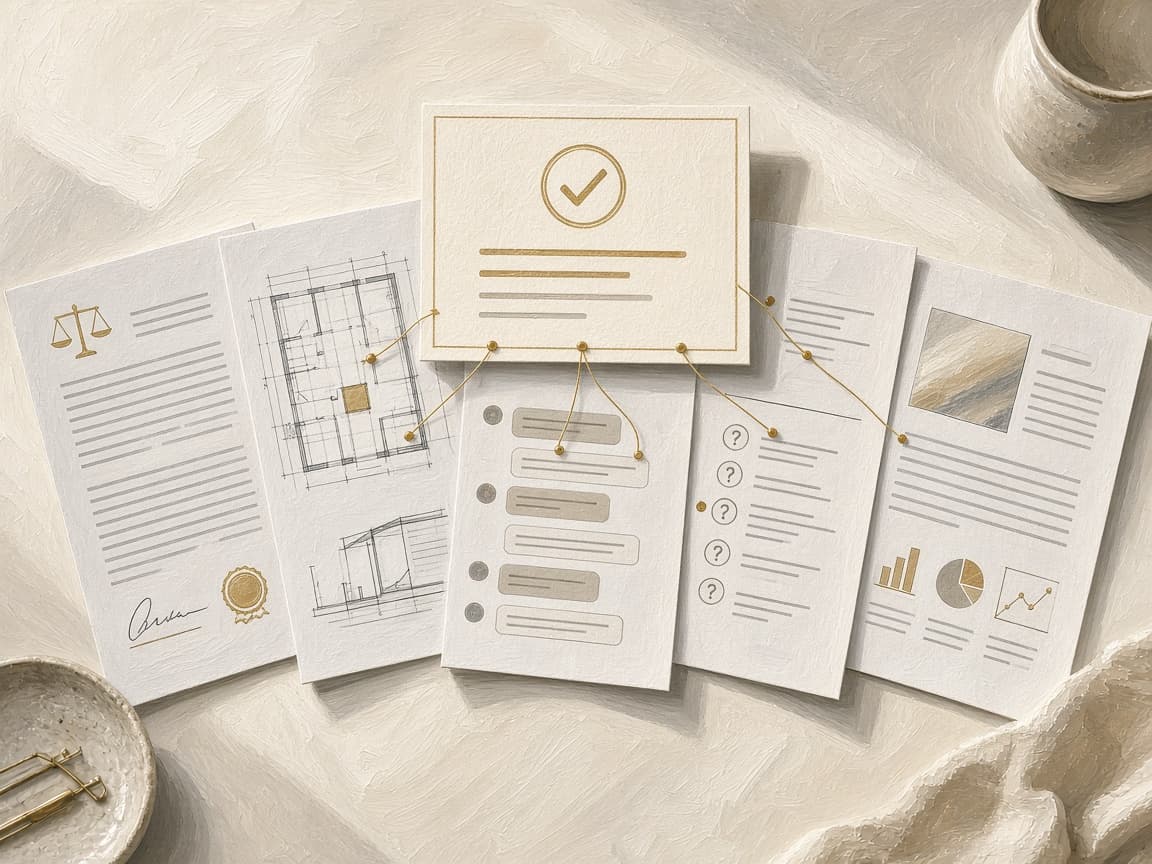
A long document rarely says an idea in one place. A policy states the rule on page 3, adds a constraint on page 17, and records an exception on page 96. The three pages use different words. They are the same idea. A full-picture answer cites a Summary that holds all three as one framework, with a link back to the document.
The Summary is what you see in the answer. It is the idea, gathered. The document stays the record underneath it. You read the Summary to see the idea whole, then open the pages it came from.
- Every mention of an idea inside the document feeds its Summary
- Different wordings of the same idea become one framework
- The answer cites the Summary, and the Summary links back to the document
The failure
Why a long document hides its own ideas
Most AI tools read a short stretch of a document and stop. If page 3 scores well, page 17 and page 96 never join it. The answer sounds complete and leaves out the constraint and the exception. The idea was in the file the whole time. It was spread across too many pages to be read as one idea.
Where a fact sits changes whether it gets used. Stanford researchers found that accuracy fell by more than 30% depending on where a fact sat in the text, even when the fact was present. Chroma tested 18 frontier models and found that near-duplicate text, the same point in slightly different words, was the content most often tied to made-up answers. Enterprise search tools get the right answer on the first try about 10% of the time, against roughly 95% for a consumer Google search.
- A strong early page crowds out the later pages of the same idea
- A fact buried in the middle of a long document gets missed
- The same idea in different words gives the answer more ways to go wrong
How it works
Group every mention of an idea, then write one Summary
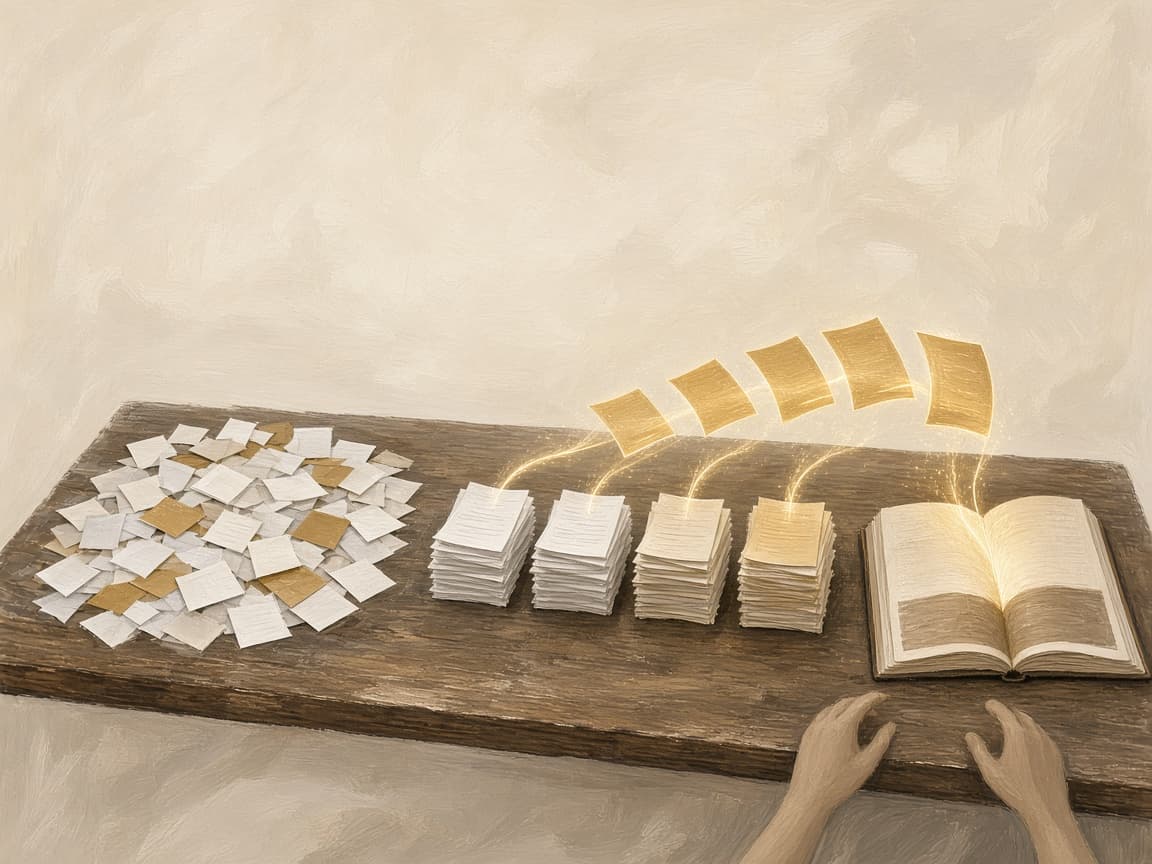
Tricky Wombat reads the document and compares its parts to each other. Parts that discuss the same idea land in one group, even when the wording changes. A page that covers two ideas contributes to two groups. It is what you would do with a printout: mark every place an idea appears, stack those pages together, and write what they say as a whole.
Each group becomes one Summary. The answer cites that Summary. The groups are built the same way every time, so the same document produces the same Summaries. Building them takes a few milliseconds.
- Compare the pages of one document to each other, by idea
- Keep the differences between those pages inside one Summary
- Cite the Summary in the answer
- The same document produces the same Summaries every time

The payoff
Less text to read, and the buried page still counts
Published tests of this approach cut the text sent onward by 46% to 90%, with no loss in answer quality across GPT-4, Llama 2, and Mixtral. A separate study found that grouping related passages and placing them together improved answer quality by up to 54% over unordered text. Less text costs less to run and gives the answer fewer places to go wrong.
The business case is a question about one long file. "What is our approach to data residency for EU customers?" may be answered by a single policy: the rule, the architecture constraint, the customer-facing wording, and a note about a regulatory change, each on its own page. A short read returns the rule. A Summary returns the approach.
- 46% to 90% less text sent onward, with the same answer quality in published tests
- Up to 54% better answer quality when related passages are grouped and placed together
- A question about one document gets the whole idea in the reply
Balance
A late page still joins the idea
In a long document the useful line is often the short one. The rule is argued for many pages. The exception is one paragraph near the end. A read that stops at the strongest early pages returns the rule and misses the exception. The Economist called a cousin of this problem the tyranny of the majority in AI research tools: the common wording wins because it is common.
Grouping by idea puts that paragraph in the same Summary as the long argument. The exception is part of the framework. When a reply surprises you, you see which pages fed the Summary and you open them.
- A long treatment and a one-paragraph exception become one idea
- A mention on a late page still reaches the Summary
- You see which pages were behind each Summary

Side by side
A Summary of the idea versus a summary of the pages
A page-by-page summary follows the document from the first page toward the last and retells what it passes. A full-picture Summary gathers every mention of an idea, wherever those pages sit, and the answer cites that Summary.
Comparison as of October 1, 2026
| Capability | Full-picture Summary | Page-by-page summary |
|---|---|---|
| Later pages of an idea are included | Yes | Partial1 |
| Different wordings of the same idea become one framework | Yes | - |
| A short mention is kept alongside a long treatment of the same idea | Yes | - |
| The same document produces the same result every time | Yes | Partial2 |
| Less text is sent onward for the same document | Yes | - |
| You see which pages fed the idea | Yes | - |
| The original document stays available | Yes | Yes |
- 1.A page-by-page summary includes a later mention only when that page happens to fall inside what got read. In a long document, it often does not.
- 2.The opening pages stay put, but any change in where the summary stops changes which mentions appear. Grouping by idea still produces the same Summary.
Legend: Yes = how Tricky Wombat answers · Partial = sometimes, depending on which pages got read · - = not part of the approach. Page-by-page summary = a summary that follows the document in order. It is not a column for a named vendor.
Full-picture answers FAQ
The questions people ask about incomplete AI answers
An answer that cites a Summary of each idea in the document you asked about. Tricky Wombat builds the Summary by gathering every place that idea appears, including places that word it differently, and writing one framework. The term is ours. The method is agglomerative clustering inside a single document, which our technical page covers in depth.
The framework for one idea inside one document. If a contract discusses liability on pages 3, 17, and 96, the Summary holds what those pages say together. The answer cites the Summary, and from the Summary you can open the pages it came from.
Most tools read a short stretch of the document and stop. An idea that continues on a later page never joins the earlier mention, so the answer is accurate about one page and silent about the rest. Stanford researchers found that accuracy fell by more than 30% depending on where a fact sat in the text, even when the fact was present.
Upload the document and ask about the idea the way you would ask a colleague. Tricky Wombat finds each place that idea appears, groups the wordings that mean the same thing, and writes a Summary. The answer cites that Summary.
Because that part scored highest, and the later mentions were never read with it. Grouping inside the document puts those later mentions into the same idea, so the Summary includes them and the answer cites the Summary.
A normal summary follows the document from start to finish and retells it in order. A full-picture Summary is organized by idea. What page 3 and page 96 say about the same thing becomes one framework, and the differences between those pages stay in it.
No. Stanford researchers found that going from 20 documents to 50 improved accuracy by about 1.5% for GPT-3.5 Turbo, and that accuracy fell by more than 30% depending on where a fact sat in the text. More text does not help. A Summary of each idea does.
No. The Summary is what the answer cites. The document remains the record. You read the Summary to see the idea, then open the pages it came from.
Better search, including the concept-level matching described on our Cognitive Resonance page, finds the right passage. A full-picture Summary organizes the passages inside the document after they are found, and the answer cites the framework. Both steps matter. Most vendors invest only in the first.
No. Grouping the mentions inside a document takes single-digit milliseconds. The answer then reads the Summary rather than every restatement, so the reply usually arrives sooner.
See a Summary of one of your own documents.
Upload a long document and ask about an idea that shows up in more than one place.
Schedule a callTechnical deep dive: Agglomerative clustering · Cognitive Resonance: finding the right passages · What is a Company Brain